Nadine Nisan
Book an intro meeting

Hello, I'm glad you're here.

Perhaps you came here because you're looking for support inside parenthood; perhaps because something in the bond with one of your children feels hard or painful; and perhaps because you know a great deal and try a great deal, and still there are moments when none of what you know manages to be within reach.

Perhaps you came as a professional, wanting to deepen your understanding of attachment, trauma and regulation, and to find a language that helps you understand the people you accompany a little differently.

And perhaps something in the way I speak and write simply met you, and you want to get to know it a little more.

So — it's very good to meet you. I'm Nadine.

Nadine Nisan

Who am I?

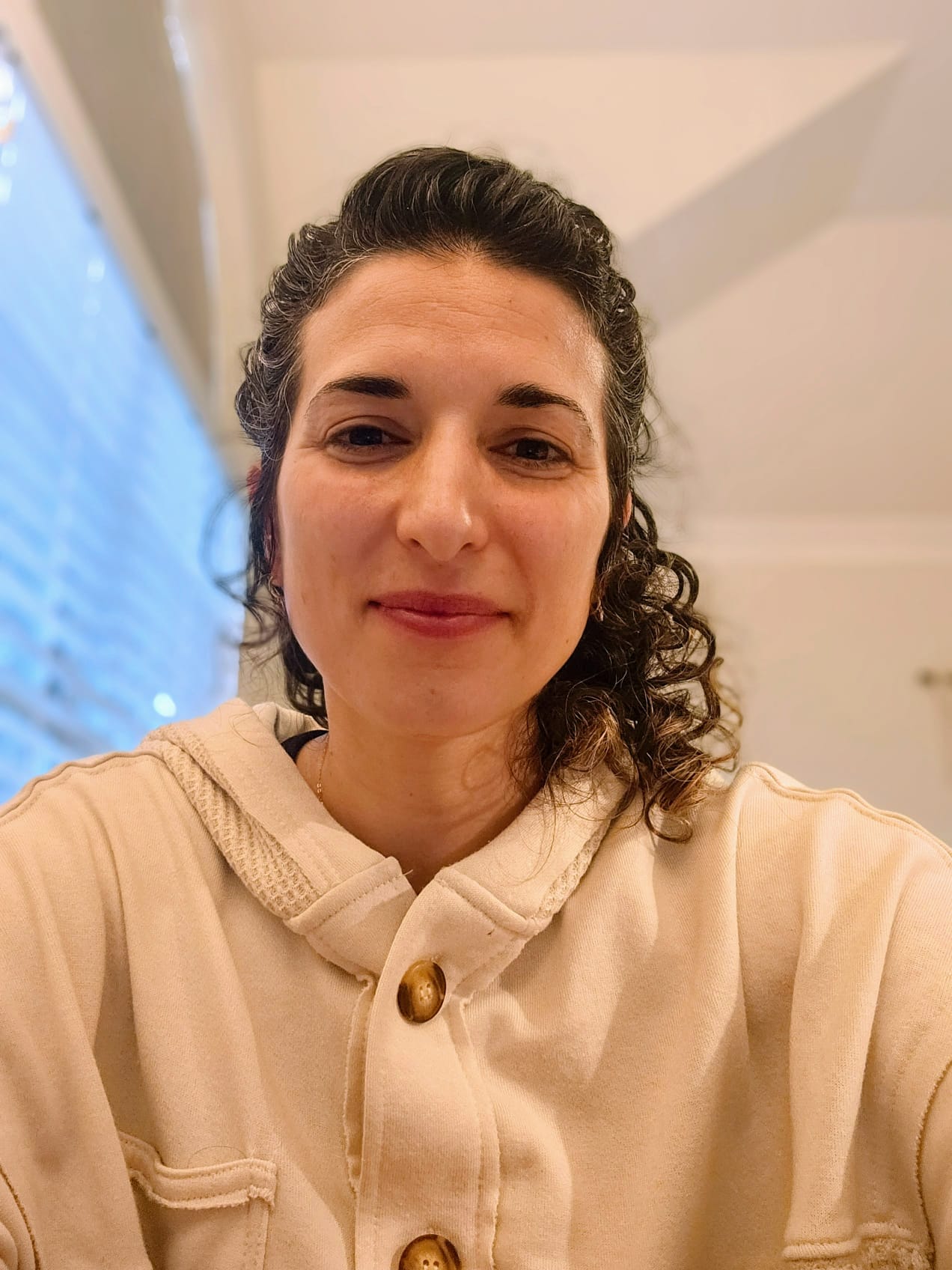
I'm married and a mother of three. About two years ago we moved as a family to Austin, Texas, and from here I accompany and work over Zoom with Israeli families in Israel and around the world.

I'm a social worker (B.A.), hold a master's degree in infant and early-childhood mental health (M.A.), am a dyadic therapist specialising in trauma (CPP), a graduate of attachment-based parent guidance, and certified in Polyvagal Theory.

For more than a decade I have worked with the bond between parents and children. In fact, my entire professional life has been with parents and children: I have experience directing settings for at-risk children and working with their parents, training staff and providing pedagogical guidance, building professional courses and lectures, supervising students, leading groups for mothers, treating parents and children, and more.

Today, alongside accompanying and treating parenthood, I supervise professionals and lead guidance groups and trainings in attachment, trauma and regulation.
What led me here?

My professional work was born out of a deep encounter with parenthood — an encounter that brought with it a great deal of love, but also pain, guilt, shame, and questions I could not at first find any answers to.

Out of that pain, and thanks to it, my path took shape and led me to go deeper into the bond between parents and children, and later into the bond between the parent we are today and the child we once were.

Over the years I studied attachment, trauma, regulation and development — but more and more I understood that this knowledge mattered to me not only in order to understand children better. It allows us to understand ourselves too.

To understand why we react the way we react.

Why certain children, or certain behaviours, activate us so particularly.

Why sometimes we know exactly what we would want to do, and still, in the moment of truth, we can't.

And why parenthood manages to touch such deep places inside us.

I believe that the more we learn to know our pain, and the more we can allow ourselves to feel it inside a safe relationship, the more we will be able not only to raise our children, but to grow alongside them.

And perhaps, slowly, the gap between the parents we wanted to be and the parents we manage to be will narrow.

How do I work?

My work combines a deep attachment lens together with an understanding of the nervous system, regulation and trauma.

I'm not only looking for what to do about a particular behaviour. I want us to understand together what lies beneath it.

In the process we learn about the nature of attachment, about children's developmental needs, about regulation and difficulties with regulation, and about the way our own experiences and story as parents meet the bond with our children.

We learn to recognise the needs and feelings beneath behaviours, to understand why there are moments when everything we know and try simply doesn't work for us, and to get to know our "operating system" as parents.

And out of that acquaintance we look together for new ways to respond, to regulate, to connect and to lead — ways that don't rest only on more effort to be "better parents", but on a deeper understanding of ourselves and of our children.

My goal is not for you to leave the process with a longer list of things you're supposed to do.

I want you to understand more.

  1. 01

    That you'll be able to give meaning to what is happening to you and to your children.

  2. 02

    That you'll feel a little safer inside your parenthood.

  3. 03

    And that out of that safety and understanding, you'll be able to choose, to respond, and to make changes that are good for your bonds with the people you love.

Parent guidance, or therapy for parenthood?

01

In attachment-based parent guidance we turn much of the gaze toward the child and toward the bond.

We learn the principles of attachment together, understand the child's developmental needs better, and look at their behaviours not only as something to be changed, but as something worth learning to read: what lies at the root of the behaviour? What is the child trying to tell us through it? And what do they need from us?

02

In therapy for parenthood we turn more of the gaze toward the parent within the bond as well.

Toward the places where we already know what we would want to do, but cannot manage to do it. Toward the moments when our reaction feels bigger than us — automatic, or beyond our control. Toward the guilt, the anger, the helplessness, the fear or the shame that parenthood can stir.

There we learn to recognise the signals of the nervous system together, to know survival patterns, to identify projections and re-enactments, and gradually to give meaning to your story too.

Because parental pain does not begin with parenthood.It begins long before.

And sometimes it is precisely the bond with our children that opens a possibility of meeting it differently.

How can we meet?

01

You can meet me in a personal process of parent guidance or therapy for parenthood — as a couple or on your own.

02

You can also meet me as a professional, in individual or group supervision, and in the groups and trainings I lead.

03

And you can simply learn with me — through the content, the lectures and the various offerings I create around attachment, trauma, regulation, and the pain that sometimes comes with being a parent.

Sometimes the pain and the difficulty feel large, overwhelming, confusing, and even shame-inducing.

You don't have to face them alone.

I make room for parental pain, and at the same time hold the possibility of healing and growth out of it.

So that we don't only raise our children in a better way, but can also grow together with them.

If something in what you've read touches you,

and if you feel you no longer want to stay with it alone,

I'm here.